
Ball Transfer Tables for Glass and Stone Processing
Glass and stone processing shops rely on ball transfer tables to move heavy sheets and slabs in any direction without lifting, and the engineering logic is identical for both materials: large, brittle, expensive panels need low-friction support that never marks the surface. According to Alwayse Engineering, a UK ball transfer manufacturer, its nylon and phenolic load units handle glass loads from 1 to 450 kg per unit, with a small contact area that reduces friction and marking.
The weight is real. Float glass weighs about 2.5 kg per square meter per millimeter of thickness, so a 3,210 x 2,250 mm sheet of 12 mm glass comes to roughly 216 kg before any cutting. Two operators can rotate and square that sheet on a ball deck, where a roller conveyor would force a single travel direction.
What makes a ball table suitable for glass
- Nylon or phenolic balls that leave no marks on coated or laminated glass
- Pneumatic retractable units that drop below the surface to create a stable cutting plane, controlled by foot or hand switch as BOSTONtec describes
- Grid spacing matched to sheet size so a panel always rests on three or more balls
- Sealed housings that keep glass dust and coolant out of the bearing assembly
Dip-Tech, a manufacturer of digital glass printing machines, builds ball transfer units into its production equipment, and Perfect Score offers 2-inch rubber-molded ball casters specifically to keep glass scratch-free on steel frames. Ahcell's CY-15A flange series is a direct fit for such printing and cutting tables, with nylon ball options for coated glass.
Stone slabs demand heavier duty
Granite and quartz slabs run far heavier than glass. Granite density is roughly 2,700 kg per cubic meter, so a 3.0 x 1.6 m slab at 2 cm thickness weighs about 260 kg, and at 3 cm about 390 kg. Shop tables answer with heavy flange-mounted units rated for higher loads per ball, spread across a tight grid.
Fabrication shops typically combine ball tables with vacuum lifters. Stone World magazine reports that the vacuum lifter is the main workhorse for slab handling in fabrication shops, and ball transfer tables sit under the same slabs so operators can position them for bridge saw cuts, edge profiling and polishing. The vacuum lifter handles vertical motion; the ball deck handles horizontal travel.
FAQ: Can ball transfers survive stone dust and water?
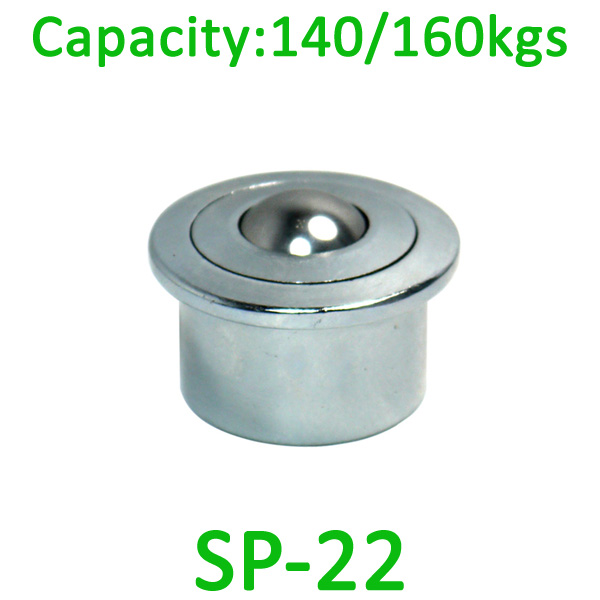
Stone processing is wet and abrasive. Standard carbon steel units corrode quickly in that environment, so most fabricators specify stainless steel or fully sealed units. Ahcell's SP-22 heavy-load flange unit is available in stainless variants that tolerate washdown, and it is a common choice for stone tables in the heaviest configurations.
The cost equation is straightforward in both industries. A ball transfer table replaces a crane call or a second operator at every cutting, printing and inspection station. For glass processors the benefit is fewer edge chips and scratches; for stone shops it is faster cycle time on slabs too heavy to rotate by hand. Both results land in the same place, which is lower cost per processed sheet.
- Pre:No Information
- Next:Ball Transfer Tables for Glass and Stone Processing 2026/11/16