
Material Handling Equipment Market Surpasses $215B in 2026
Material handling equipment market reached $215.97 billion in 2025, exceeding 2021 projections of $156 billion by $75 billion. The industry shows no signs of slowing. Technavio projects an additional $18.79 billion growth by 2030 at a 7.2% CAGR. Knowledge Sourcing forecasts the market reaching $328.6 billion by 2031.
What's driving this? Labor shortages, stricter safety standards, and faster throughput demands from e-commerce. BUILT Systems reports that material handling accounts for 20 to 30% of total manufacturing labor costs, with over 1 million workers in the US alone. That makes it a prime target for efficiency gains.
APAC accounts for 42.7% of growth, driven by e-commerce expansion in China and India. North America and Europe are investing too, partly due to nearshoring as manufacturing relocates closer to consumer markets. These new facilities need conveyor systems, automated storage, and sortation infrastructure built from scratch.
Safety ranks first among the forces shaping 2026, according to Align Production Systems. Forklift incidents and manual handling injuries remain common. Manufacturers are turning to engineered transporters with predictable travel paths and controlled speeds. AGVs as forklift alternatives are part of this shift. The other three forces identified are practical automation, electrification, and flexible engineering.
Automation is becoming more targeted. The goal is not a fully autonomous factory but solving specific repetitive, long-distance, and heavy-load handling problems. Conveyor systems, AS/RS, and AGVs can boost throughput by 30% or more in stable operations, per BUILT Systems. But automation does not fix unstable processes. It accelerates inefficiency. Standardizing manual workflows first remains a prerequisite.
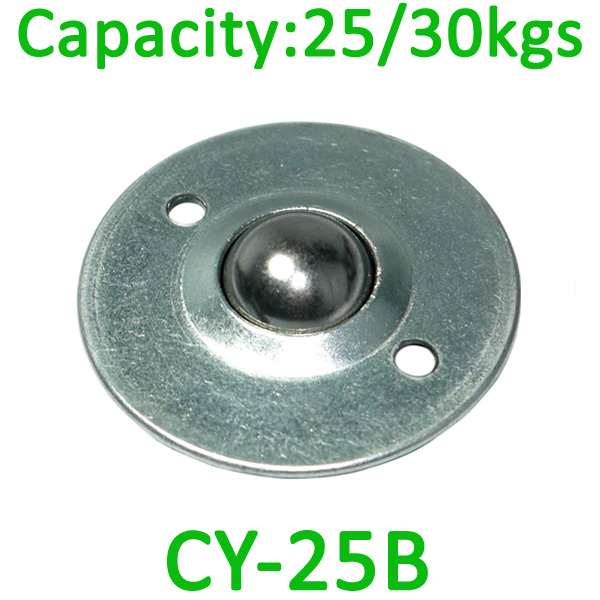
Ball transfer units serve a specific role within these systems. At conveyor line merge points, sortation junctions, and AGV-to-conveyor handoff stations, ball transfers provide omnidirectional adjustment without complex mechanical diverters. SP series units handle loads up to 4,000 kg for pallet transfer stations. BTFM series handles up to 8,000 kg for heavy-duty applications. Light-duty flange-mounted units like the CY-25B enable smooth rotation at packaging and inspection stations.
Facility planners are prioritizing modular and reconfigurable equipment over fixed installations. Ball transfer units fit this approach directly: they install quickly, can be repositioned when needs change, and support the flexible layouts that material handling systems now require.