
Ball Transfer Units in Aerospace Manufacturing and Assembly
Ball Transfer Units in Aerospace Manufacturing and Assembly Operations
Aerospace manufacturing demands exceptional precision, safety, and efficiency at every stage of production. From assembling fuselage sections to positioning aircraft engines for installation, the ability to move heavy, oversized components with millimeter accuracy is critical. Ball transfer units (BTUs) have become an integral part of this process, providing omnidirectional load-bearing surfaces that allow skilled technicians to maneuver multi-ton assemblies with minimal effort.
A Historical Partnership with Aviation
Omnitrack, a pioneer in heavy-duty ball transfer technology, supplied its first units to the aircraft industry in 1958 for the de Havilland Comet, the world's first commercial jetliner. Since then, BTUs have supported the assembly of the Eurofighter Typhoon, Airbus commercial aircraft, and the Boeing 787 Dreamliner. In the Dreamliner program, Omnitrack 9840 tolerance-ring units were used in landing-gear fatigue testing, supporting a 98-ton rig through over 100,000 cycles while allowing precise repositioning between tests. This long history demonstrates the aerospace industry's trust in BTU reliability under extreme conditions.
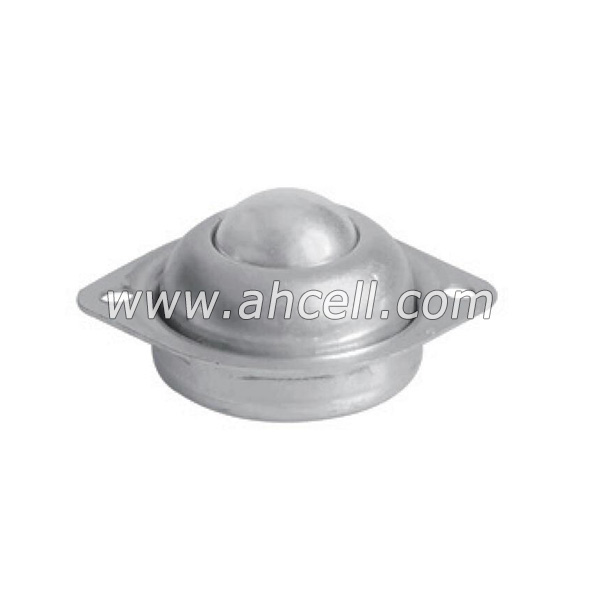
Aircraft Assembly Jig Applications
In modern aircraft production, wing-to-fuselage mating is one of the most delicate operations. The wing must be positioned so that thousands of attachment bolts align perfectly with their corresponding holes in the fuselage casting. Omnitrack 9352 ball transfer units are used in the final positioning fixtures, allowing the wing to be moved incrementally in all six degrees of freedom across the ball deck surface. The extremely low friction of heavy-duty BTUs means that a single technician can make micro-adjustments to a wing section weighing several tons, achieving alignment tolerances measured in tenths of a millimeter.
Similar BTU-based fixtures are used for horizontal stabilizer installation, cargo door fitting, and landing gear assembly. In each case, the ball transfer deck is a precision positioning platform that replaces traditional crane-and-sling methods, reducing both cycle time and the risk of impact damage during mating operations. Flange-mounted and stud-mounted BTUs are typically specified for these applications because they provide secure, repeatable positioning without creeping under vibration.
Engine Handling and Transport
Aircraft engine transport and installation present unique challenges. A modern turbofan engine such as the General Electric GE9X measures over 4 meters in diameter and weighs more than 9,000 kg. Moving these engines from storage to the assembly line, and then positioning them for pylon attachment, requires a handling system that distributes load evenly while allowing omnidirectional movement in confined spaces.
Ball transfer units configured in custom-engineered ball decks provide the solution. The decks are embedded into engine transport dollies and assembly stands, allowing engines to be pushed laterally, rotated, and aligned with the aircraft pylon without lifting equipment. Heavy-duty BTUs rated at 1,000-2,000 kg per unit are common in these applications, arranged in grids that distribute the engine weight across multiple units with a safety factor of three or more per industry best practice. Stainless steel units are preferred to resist corrosion from jet fuel, hydraulic fluid, and cleaning solvents present in engine maintenance environments.
Air Cargo Deck Integration
While not a direct manufacturing application, the use of BTUs in aircraft cargo holds is closely related to aerospace logistics. Modern cargo aircraft and many passenger aircraft feature ball transfer decks in their cargo compartments to allow Unit Load Devices (ULDs) to be maneuvered into position for flight. Individual BTU capacities of 500-2,000 kg per unit are typical, with stainless steel construction specified for corrosion resistance against de-icing fluids and salt spray exposure on the apron. The low coefficient of friction provided by precision ball transfer units enables a single ground handler to reposition a loaded ULD weighing several tonnes, reducing aircraft turnaround time and improving operational efficiency.
Specialized Requirements for Aerospace BTUs
Aerospace-grade BTUs differ from general industrial units in several respects. First, load ratings are typically higher, often exceeding 2,000 kg per unit, with some heavy-duty models such as the Omnitrack range supporting up to 4,550 kg. Second, corrosion resistance is paramount, stainless steel housings and balls, or carbon steel with specialized zinc-nickel coatings, are standard specifications. Third, the internal ball race design must function without loss of load capacity at any angle of orientation, since aerospace fixtures may mount BTUs in sideways or inverted positions. Patented endless-track designs, such as those developed by Omnitrack since 1954, address this requirement by recirculating support balls rather than using a fixed hemispherical cup.
Temperature tolerance is another critical factor. Aerospace assembly environments range from climate-controlled clean rooms to unheated hangar bays. BTUs specified for these applications must operate reliably from -30°C to over 100°C without lubrication failure or dimensional changes that could affect positioning accuracy. Bosch Rexroth and SKF are among the manufacturers offering units verified for this temperature range.
Case Study: Wing Mating at Airbus
Airbus wing assembly facilities use customized ball transfer fixtures for the final insertion of wing terminal pins and fittings into fuselage castings. The fixtures incorporate an array of heavy-duty BTUs mounted on a rigid steel frame. The wing assembly, supported on the ball deck, can be translated and rotated by hand to achieve perfect alignment. Once positioned, the fixture locks the wing in place while bolting proceeds. This approach has replaced older methods that required overhead cranes and multiple riggers, reducing mating time by approximately 40% while improving alignment quality.
Future Trends
As aircraft manufacturing moves toward composite-intensive designs and larger single-aisle platforms, the demand for precision positioning systems continues to grow. Spring-loaded BTUs are gaining traction in automated drilling and fastening fixtures, where the retractable ball feature allows the component to be positioned smoothly and then clamped firmly. Smart BTUs with embedded position sensors are also being explored for real-time feedback in automated assembly cells. The aerospace industry's push for faster production rates and higher quality standards ensures that ball transfer technology will remain a vital component of the manufacturing toolkit for decades to come.