
Ball Transfers in Auto Paint Booths: Rotation & Load Ratings
Automotive paint booths demand precise part rotation and smooth material flow at every station. Chain-on-edge conveyor systems, like those built by Arnold Machine, transport parts through sequential pre-heat, primer, and top-coat stations using servo-controlled spindles that rotate each part in front of spray guns. FANUC Paint Mate robots and Krautzberger spray guns handle the coating, while Keyence flow sensors verify primer application before the top coat proceeds. Each spindle needs at least two full rotations in front of every gun to ensure even coverage on cylindrical substrates from 1 to 5 inches in diameter.
Where ball transfer units fit in: loading and unloading zones at the front and back of the paint line. Operators at Arnold Machine's load station have 6 feet of accessible fixtures for manual part placement. Ball transfer tables at these positions let workers rotate heavy fixtures with one hand, aligning parts onto spindles without straining. LEWCO's ball transfer conveyor assemblies, used by automotive parts suppliers, combine ball tables with pneumatic pushers and lift stations to buffer full and empty containers at operator workstations. A typical setup mounts ball transfers onto scissor lift tables so the working height adjusts to each operator.
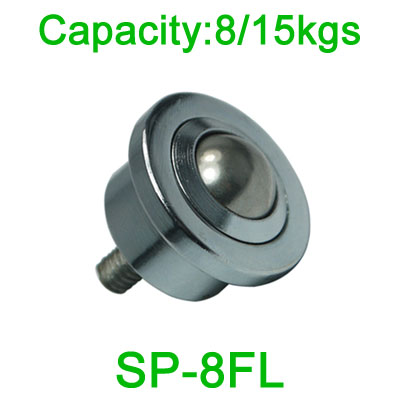
Load ratings matter because paint booth fixtures carry significant weight. Omnitrack's heavy-duty flange-mount ball transfers handle up to 8000 kg per unit with a friction ratio below 0.005, meaning a 500 kg fixture assembly needs less than 2.5 kg of force to rotate. Their 82 and 92 series flange-mounted units operate in temperatures from -50 to 260 degrees Celsius, covering the range from ambient loading zones to the 130-degree pre-heat ovens found in Arnold Machine's chain-on-edge systems. Ahcell's SP series flange-mount units cover ball diameters from 8 to 90 mm, with the SP-90 rated for extreme-duty loads in heavy equipment assembly.
Accudraft builds crane and conveyor paint booths that integrate with overhead rail systems for heavy industrial parts. Their drive-through design uses unidirectional workflow to keep production moving, and ball transfer tables at entry and exit points let operators pivot parts into the correct orientation before the conveyor pulls them into the spray zone. The company's spark-proof exhaust fans with regreasable ball bearings are rated for hazardous environments, which matters when ball transfers are installed near solvent-based coating stations.
For paint booth applications, stainless steel ball transfers are the common choice. Solvent fumes, overspray mist, and routine washdown cycles corrode standard carbon steel. Sealed units with felt wipers, like those in Omnitrack's 9000 series, keep debris out of the ball race while still allowing free rotation. In high-temperature zones above 150 degrees Celsius, removing the felt seal and running the unit dry prevents seal degradation. Drain channels in the housing let overspray runoff escape rather than pooling around the ball.
Selecting the right ball transfer for a paint booth comes down to three factors: load per unit, operating temperature, and contamination resistance. A 15 mm flange-mount unit like the CY-A series handles lighter fixture brackets at ambient loading stations. Heavier rotary fixtures near ovens call for the SP-45 or SP-60 with their reinforced carbon steel construction. And wherever overspray or cleaning chemicals are present, sealed stainless steel units with drain channels outlast open designs by months.
- Pre:Ball Transfers Cut MSD Risks in Heavy Plate Rotation 2026/5/15
- Next:Ball Transfers in Food Conveyors: Washdown Standards 2026/5/13