
Ball Transfer Tables Cut Strain at Assembly Workstations
Manual handling injuries cost U.S. employers billions of dollars each year, according to OSHA. At assembly workstations, where operators rotate and reposition components dozens of times per shift, the repetitive twisting and lifting adds up fast. Ball transfer tables offer a practical fix: a grid of omnidirectional bearing units set into a flat work surface that lets a single worker move and rotate heavy items with a push of the hand.
Omtec's PBT Ball Transfer Table illustrates how the concept works in production. The table has two modes. In ball-transfer mode, the units sit flush with conveyor rollers so items glide freely in any direction. In stabilized mode, the balls retract below the surface, creating a fixed platform for tasks that need a steady base like assembly or inspection. One switch flips between the two. The design also eliminates pinch points that conventional conveyors leave exposed. Notable users include Tesla, Cummins, and Amazon, according to Omtec.
Cisco-Eagle supplies ball transfer tables in frame heights of 2-1/2 inches and 3-1/2 inches, with load capacities up to 620 lbs. Ball centers come in 3-inch and 4-inch spacing, and widths range from 12 to 42 inches. Sections connect end-to-end, so a workstation can grow as the line changes. A 3-inch ball center table at 3-1/2 inch frame height starts around $149 per foot, while a 4-inch center version runs about $90 per foot. Mallard Manufacturing takes a similar approach with configurable ball exposure and food-grade compliant frames for washdown areas.
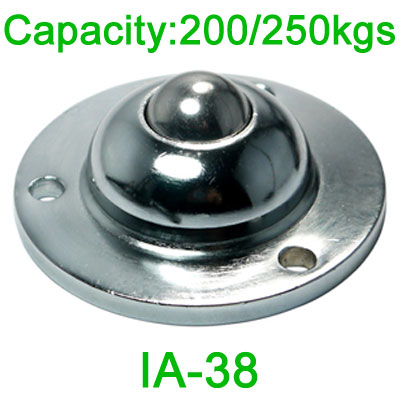
Choosing the right ball transfer unit matters as much as the table itself. For light assembly work, units like the CY-H base-mount series (ball diameters from 8 to 30 mm) sit flush in recessed holes and handle loads up to 30 kg each. Medium-duty applications call for the SP flange-mount series, which ranges from ball diameters of 8 to 90 mm and carries up to 4,000 kg per unit. The IA-38 insert-type unit, rated at 200 kg, bridges the gap between light and medium loads and drops into existing conveyor frames without modification. All conform to ISO 15299 dimensional standards for interchangeability.
Ball transfer tables fit lean manufacturing and one-piece flow environments where flexibility counts. Packing stations, inspection points, receiving docks, and assembly cells all benefit from 360-degree item rotation without lifting. For plants looking to cut injury claims and speed up manual processes, the return is straightforward: less strain, faster throughput, and one operator doing what used to take two.
- Pre:Ball Transfer Units Speed Up Packaging Direction Changes 2026/5/12
- Next:Ball Transfer Units Cut Baggage Handling Jams at Airports 2026/5/10