
Ball Transfer Units Cut Baggage Handling Jams at Airports
Airport baggage handling systems face growing pressure as passenger volumes climb. The global BHS sector reached $10.14 billion in 2026, up from $9.4 billion the year before, according to The Business Research Company. That growth brings real engineering challenges: transfer points between conveyors remain the number-one failure zone, where luggage straps, wheels, and tags get caught in gaps and bring entire sorting lines to a halt.
Screening conveyors alone process over 600 bags per hour at speeds near 100 feet per minute, as Flexco's airport division has documented. A single jam at these rates cascades fast, delaying connections and triggering mishandled-bag claims. At transfer junctions where conveyor lines cross, merge, or redirect, ball transfer units give operators and automated systems a way to rotate and reposition bags in any direction without complex mechanical diverters. Dubai International Airport installed ball transfer tables at its sorting stations to handle precisely this problem.
Jason Odey, Director of Global Baggage Excellence at Air Canada, told Future Travel Experience that 2026 is "the execution year." The industry is moving past pilot projects and proving automation, tracking, and predictive maintenance in live operations. Individual Carrier Systems (ICS), where each bag rides in its own tracked container, are gaining ground even at smaller airports like Grand Rapids. BEUMER Group's CrisBag ICS, for instance, eliminates baggage jams entirely by enclosing each item, and the RFID-tagged carriers make screening faster.
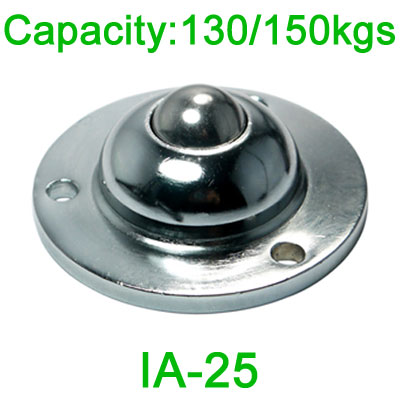
But ICS is expensive and takes years to deploy. Most airports still rely on conventional conveyor networks with pusher-style diverters. That is where ball transfer arrays prove their value. Installed at merge points and manual sort stations, flange-mount and stud-mount BTUs let workers pivot heavy suitcases 90 or 180 degrees with a push, no lifting required. The IA series insert-type units, rated for heavy loads, drop into existing conveyor frames without major modification. Interroll drum motors and rollers already run luggage lines on every continent; adding BTU transfer tables at key junctions is a straightforward retrofit.
Computer vision and RFID tracking now flag jams within seconds, yet the physical solution still matters. As airports upgrade from legacy belts to smarter sortation, ball transfer units close the gap between detection and resolution — a stuck bag can be freed and redirected in seconds on a BTU-equipped table, versus waiting for maintenance crews on a fixed conveyor. For airport engineers specifying BHS upgrades, selecting the right BTU load rating and mounting type for each transfer point is a practical step that reduces downtime without the capital outlay of full ICS conversion.