
Ball Transfer Load Ratings: How to Choose the Right Unit
Choosing a ball transfer unit starts with one number: the load rating. According to Alwayse Engineering, the required per-unit capacity is found by dividing the total load by the minimum number of units supporting it at any moment, then applying a safety factor, typically two or three. Get this wrong and the load ball develops flat spots, rotation turns rough, and the unit fails early. Get it right and the table runs for years with almost no maintenance.
Spacing comes first, because spacing decides how many units actually share the load. Elesa, the Italian machine parts manufacturer, states that the maximum distance between ball transfer units on a flat surface is obtained by dividing the smaller load dimension by 2.5. That geometry rule guarantees a load is always supported by at least 3 ball transfer units, which also stops the load from tipping. Each unit then carries a third of the total weight, assuming an even, flat-bottomed load.
The load calculation, step by step
Alwayse works a concrete example. A table must carry a 600 kg crate. Assume only four units bear the load at the worst position, near an edge. Divide 600 by 4 and you get 150 kg per unit. Applying a safety factor of two for steady handling, each unit should be rated to at least 300 kg, which places it in the heavy-load tier. If the crate is dropped onto the table rather than placed, use a factor of three and specify spring-loaded units to absorb the impact. JW Winco offers a simpler rule of thumb: divide the weight of the load by three to find the required load capacity.
Why the minimum count matters
A flat, rigid item is supported by at least three units at any instant. As it moves, the count changes, and at edges or corners it can drop to three or four. Sizing on the total number of fitted units is a common mistake. The safe assumption is the minimum number in contact under load. Alwayse rates its units in three tiers: light (0 to 100 kg), medium (101 to 249 kg), and heavy (250 kg and above), with heavy-duty models reaching 12,000 kg.
Beyond the load number
Load rating is necessary but not sufficient. Bosch Rexroth lists five selection criteria for ball transfer units: minimum friction, installation position, ambient conditions, required performance, and service life. Its units handle conveying speeds up to 2 m/s and operate from -30 °C to 100 °C, in sizes from 8 mm to 120 mm. Omnitrack heavy-duty units push further: 8,000 kg per unit, a friction ratio below 1:0.005, and a temperature range of -50 °C to 260 °C.
Key selection questions
- What is the maximum weight of the items to be conveyed?
- How many ball transfer units will share the load?
- What are the item dimensions, and is the bottom flat?
- Which material suits the environment: stainless steel, carbon steel, or nylon?
- Which mounting method: flange, stud, or drop-in?
FAQ: How many ball transfer units support a load at once?
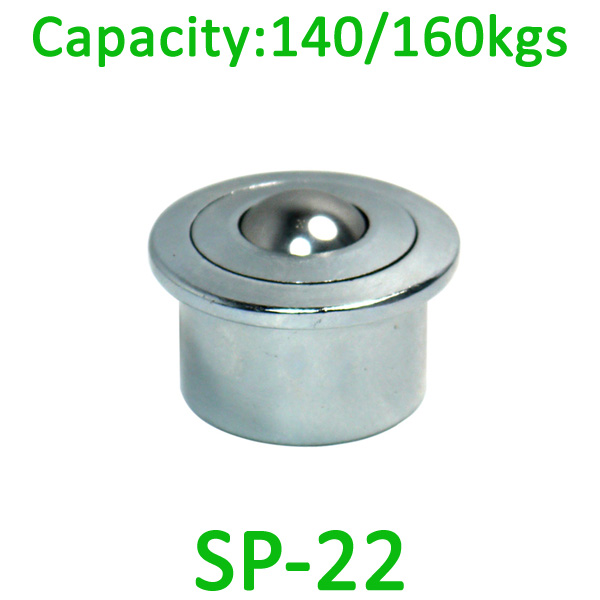
At least three, and the number changes as the load moves. At edges and corners it can drop to three or four, so always size for that worst case, never for the total number of units fitted to the table. For flange-mount installations, Ahcell offers the SP-22 heavy-duty unit for loads up to 4,000 kg, while the CY-15A suits lighter tabletop work. Ahcell, a China-based ball transfer manufacturer, publishes per-unit ratings for each series so engineers can run the calculation against real numbers.
The math is simple. Divide the load by the minimum supporting units, apply a safety factor of two or three, and verify the spacing rule. Units that pass that check will carry the load without flat spots, and the table will keep rolling for years.
- Pre:No Information
- Next:Ball Transfer Tables for Order Picking and Manual Sortation 2026/9/7