
Ball Transfers in Medical Cart Design: Rotation and Mobility
Medical equipment carts must navigate tight hospital corridors, rotate in small patient rooms, and stay stable during procedures. The casters and wheels that provide this mobility are well documented, but ball transfer units also play a role in specialized carts, enabling smooth 360-degree rotation of heavy equipment on the cart platform itself.
Scott-Clark Medical identifies several critical cart types in hospitals: anesthesia carts, crash carts, medication carts, and isolation carts. Crash carts in particular must be deployable in seconds with a stable yet narrow wheelbase and lockable swivel casters. What happens when the equipment on top of that cart, such as a patient monitor or defibrillator mount, also needs to rotate for bedside access? A ball transfer surface embedded in the cart top allows devices to spin freely without lifting, reducing nurse strain during repositioning.
Scott-Clark Medical notes that medical carts need accessible and easy-to-clean surfaces for thorough decontamination. Stainless steel construction is preferred because it is corrosion-resistant and medically inert. This requirement extends to any ball transfer units used on medical carts. Stainless steel BTUs, such as those in Ahcell's SP series (available in Ø8-90mm ball diameters), meet the ISO 15299 dimensional standard and can be specified in 304 or 316L stainless for washdown compatibility. CleanAir Solutions builds cleanroom transport carts from 316L stainless steel with 35 Ra surface finishes and electropolished welds to eliminate particle traps, setting the cleanliness benchmark that any BTU in regulated environments must match.
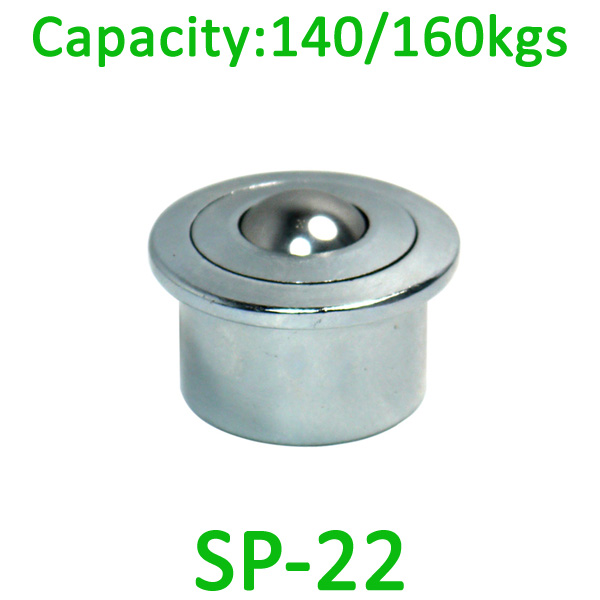
In cleanroom and pharmaceutical manufacturing, Terra Universal offers BioSafe stainless steel carts and laminar flow transport carts that maintain HEPA-filtered air during movement between ISO Class 4 and 5 zones. When heavy components like chemical reservoirs or gas cylinders need repositioning on these carts, a few flange-mount ball transfer units allow 360-degree rotation without removing the item from the clean zone. The SP-22, for example, supports loads up to 220 kg per unit in its carbon steel variant, with the stainless version offering the same load rating and full sterilization compatibility.
TouchPoint Medical reports that its Vexio device carts provide secure equipment mobilization, letting clinicians spend more time with patients and less managing equipment. Adding a ball transfer platform to equipment carts extends that efficiency: instead of unbolting and repositioning a 30 kg patient monitor, a nurse can simply rotate it on the ball transfer surface. For heavy medical devices, Omnitrack's heavy-duty BTUs rated at 8,000 kg per unit with a friction ratio below 0.005 show the upper end of load capacity. Most medical applications need only 30-150 kg per unit, within the range of standard flange-mount and stud-mount BTUs.
Hospital equipment specifications increasingly require washdown-rated components, IP-rated enclosures, and materials that withstand chemical disinfectants. Ball transfer units with stainless housings and sealed ball assemblies meet these demands, making them a practical addition to medical and cleanroom carts where equipment rotation is a daily requirement.
- Pre:Conveyor Direction Change Systems: 4 Methods Compared 2026/5/19
- Next:Steel Coil Handling: Ball Transfer Units Reduce Manual Risks 2026/5/17