
Flange Mount Ball Transfers Dominate $1.8B Market in 2026
The global ball transfer unit market reached $1.8 billion in 2025 and is projected to hit $3.1 billion by 2034, growing at 6.2% CAGR according to DataIntelo research. Among the major mounting categories, including flange, stud, drop-in, and recessed types, flange mount ball transfers hold the largest share due to their straightforward installation and broad load range.
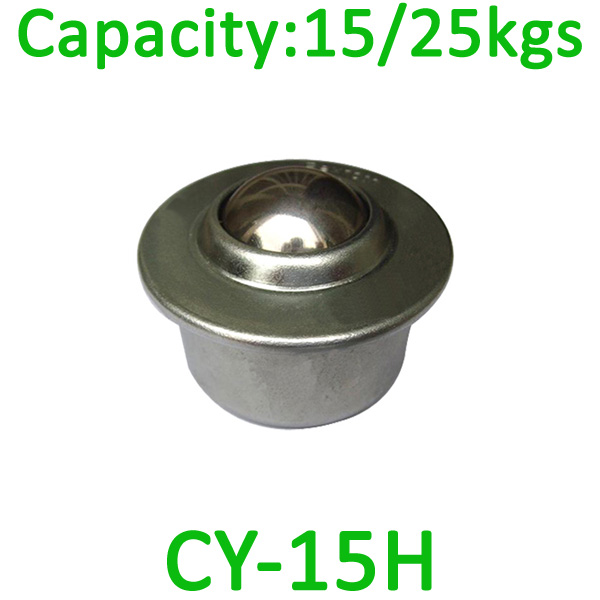
Flange mount units feature an integral flange with bolt holes that attaches directly to flat surfaces. Installers drill through-holes and bolt the unit down, with no tapped threads required. This makes flange mounting the default choice for conveyor beds, transfer tables, and assembly workstations where speed of installation and maintenance access matter. Hudson Bearings reports that flange-mounted designs effectively support high-capacity loads while reducing vibration transfer to the mounting surface.
Load capacity in flange-mount configurations spans an unusually wide range. Light-duty CY-A series units handle loads up to 30 kg per unit with ball diameters from Ø15 to Ø38 mm, available in both carbon steel and stainless steel. At the other end, the BTFM flange-mount heavy series supports up to 8,000 kg per unit with ball diameters from Ø76 to Ø254 mm. This breadth is one reason flange mounting accounts for the majority of BTU installations worldwide.
The stainless steel ball transfer segment, valued at $462.8 million in 2025 per Grand Research Store data, relies heavily on flange-mount construction. Food processing, pharmaceutical, and washdown environments demand corrosion-resistant materials, and the flange design simplifies disassembly for cleaning cycles. Norelem's installation guidelines note that proper flange-mount spacing calculations depend on the weight and surface area of transported goods, with standard pitch intervals around 200 mm for typical warehouse loads.
Ball transfer units conforming to ISO 15299 ensure dimensional interchangeability across manufacturers. This standard covers tolerances for flange bolt patterns, housing dimensions, and ball seat geometry, allowing engineers to specify Ahcell CY-A or BTFM series units as direct replacements for Alwayse or Omnitrack equivalents in existing conveyor layouts.
- Pre:Automotive Assembly Lines Adopt Ball Transfer Units 2026/5/5
- Next:Packaging Machinery Market Reaches $71B in 2026 2026/5/3