
Ball Transfer Tables Speed Up Warehouse Sorting Operations
Warehouse sorting operations depend on fast, accurate direction changes at conveyor junctions. Ball transfer tables give operators and automated systems the ability to rotate and redirect packages in any direction without mechanical pushers, diverters, or pneumatics. According to Cisco-Eagle, ball transfers serve as a gravity-based manual transfer method that integrates directly into conveyor lines, making them a practical fit for low-to-moderate throughput sorting zones where simplicity matters more than speed.
At sorting stations, the layout of ball units determines how well the table performs. Ashland Conveyor specifies that a product needs at least five balls underneath it at all times to move efficiently. Ball centers range from 2 to 6 inches: smaller packages require tighter spacing, while large flat-bottomed cartons work fine on wider patterns. Tables built with 1-inch steel balls on 1/4-20 center-post mounts can handle up to 3,100 pounds of uniformly distributed load on a 5-foot section, though individual item weight should stay under 150 pounds since only three balls typically support the product at once. Drop-in insert plates let facilities convert existing roller conveyors by removing rollers and bolting ball assemblies into the same frame.
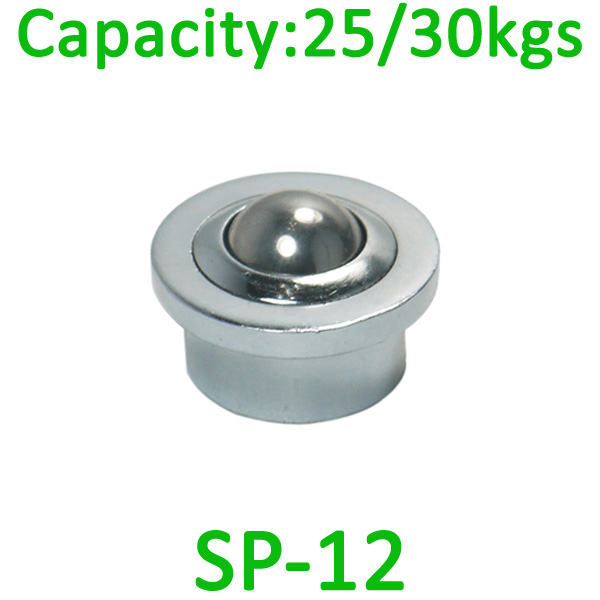
The SP-12 flange-mount ball transfer unit from Ahcell handles medium-duty sorting loads with a 12mm carbon steel ball, rated for continuous operation in conveyor junction zones. Its flange-mount design distributes load across the mounting surface, reducing localized stress on the table frame during repeated direction changes. For heavier pallet-transfer sorting points, the SP series extends to 90mm ball diameter with load capacities up to 4,000 kg, while the BTFM flange-mount heavy series reaches 254mm balls rated for 8,000 kg.
Sortation alternatives include pop-up wheel sorters and timing belt transfers for higher throughput, but these add actuators, sensors, and maintenance complexity. Omnia Wheel, an Australian manufacturer, takes a different approach with motorized omni-wheel modules that sort at any angle without pneumatics or pop-ups. Their system runs on 24V power, averages 64 dB noise output, and can be reprogrammed for new sort patterns as warehouse layouts change. Traditional ball transfer tables remain the lower-cost option for facilities where manual or semi-automated sorting is sufficient.
Warehouse automation continues to grow at 12 to 15 percent annually, and ball transfer tables fit naturally into both manual and automated environments. At AGV handoff points, BTU arrays absorb positioning variance without requiring precise alignment. At robotic picking stations, operators can rotate items to any orientation without gripping mechanisms. From 50-carton-per-minute pusher-fed lines to manual sortation at T-junctions, ball transfer tables cut repositioning time and reduce physical strain on workers.
- Pre:Steel Coil Handling: Ball Transfer Units Reduce Manual Risks 2026/5/17
- Next:Ball Transfers Cut MSD Risks in Heavy Plate Rotation 2026/5/15