
Ball Transfers Cut MSD Risks in Heavy Plate Rotation
Rotating steel plates and heavy dies on workbenches accounts for a significant share of musculoskeletal disorder (MSD) cases in manufacturing. Data from OxMaint indicates that MSD injuries make up roughly 25 percent of all manufacturing workplace incidents, costing U.S. industry over $225 billion annually. The repetitive twisting, pulling, and repositioning of heavy flat loads puts operators at risk for lower back strains, shoulder impingements, and wrist injuries. NIOSH's lifting equation sets clear limits on acceptable push and pull forces, yet many shops still rely on pry bars and muscle to turn 500 kg steel plates.
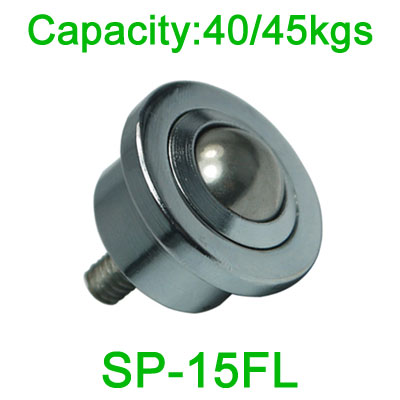
Ball transfer tables directly address this problem by replacing sliding friction with rolling contact. According to Omnitrack, their heavy-duty units support up to 8000 kg per individual ball and maintain a friction ratio below 0.005, meaning the breakaway force to move a 4000 kg load is under 20 kg. Their 82 and 92 flange-mounted series are commonly specified for plate rotation stations where loads must turn freely at any angle. The units operate in temperatures from -50 to 260 degrees Celsius, making them suitable for both cold-storage staging areas and hot forming lines.
BOSTONtec takes the concept further with pneumatic retractable ball transfer tables. When operators need a solid surface for clamping or welding, a foot switch retracts the balls below the table surface. When rotation is needed, the balls pop back up. This dual-mode design eliminates the need for separate positioning and processing stations, cutting floor space requirements and reducing the number of load transfers between work areas. BOSTONtec's tables also integrate surface rollers that move loads directionally to and from the ball zone, creating a hybrid workstation.
LEWCO's ball table lineup offers three configurations for different integration needs: the BPA plate-style unit sits on existing workbenches or scissor lifts, the BPB deep-plate style functions as a standalone table, and the BPC conveyor-frame style couples directly to gravity roller lines. All three patterns accommodate standard 1.5-inch or 3-inch ball spacing. The 3-inch spacing is preferred for heavier plates where fewer contact points are acceptable but each ball must carry a higher rated load. LEWCO lists target industries including aerospace, automotive, military, and cabinet manufacturing.
For facilities processing heavy steel coils, die sets, or mold blocks, specifying the right ball transfer makes the difference between a safe rotation and a strain injury. Flange-mount units with load ratings above 2000 kg per ball, combined with a table height matched to the operator's elbow level, keep push forces within NIOSH recommended limits. One avoided back injury saves between $40,000 and $80,000 in direct workers' compensation costs, according to the Bureau of Labor Statistics.