
Ball Transfer Units for Steel Coil Turntable Rotation
Steel coils spend most of their handling time being moved, not processed. Rotation is where the risk sits: a 10-ton coil hanging on a crane hook needs a stable surface to spin on, and the coil car tracks that feed slitting and cut-to-length lines have to change direction without jamming. Ball transfer units solve both ends of that problem because they rotate in place and carry load in any orientation.
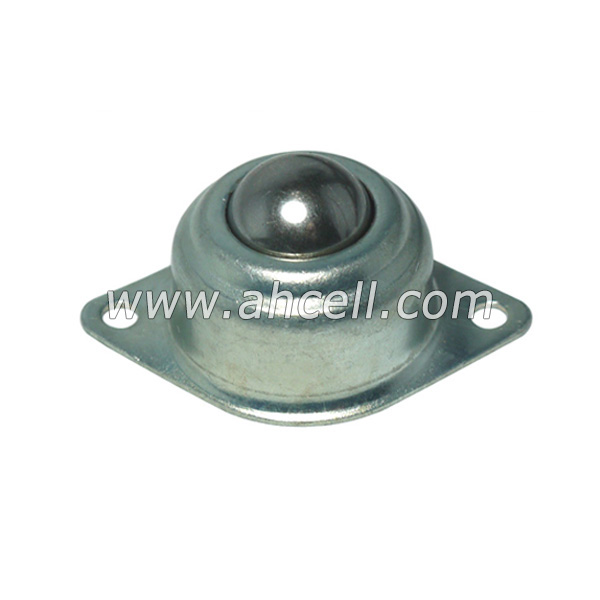
The heavy-duty ball transfer unit was invented for exactly this kind of duty. Omnitrack designed and patented the range in 1954 for a British Steel plant, where large drums of molten steel had to be moved safely at high temperature. The first attempt used inverted castors made by Autoset, but castor trail prevented instant directional change. The ball unit removed that offset, and the original OTSF 4070 ran at 2000 kg capacity in 150 degrees centigrade until the plant closed in 1972.
Modern heavy-duty units carry far more. Omnitrack rates individual units to 8000 kg, with a coefficient of friction below 1:0.005, meaning the breakaway force is under 0.5 percent of the load. Operating temperature spans -50 to 260 degrees C, and intermittent speed reaches 2 m/s at full load. The heavy-duty construction uses an endless track or full race recirculation system instead of the cup-and-ball chamber found in light-duty ranges, which is what lets the full load apply at any angle of inclination.
Turntable integration follows the same logic. Power Pak Conveyor and LEWCO build powered rotators that spin loads 360 degrees, while Hytrol turntables index in 90-degree increments to feed adjacent lines. Inside those tables, the load still rests on a ring of ball transfer units. Flange-mounted units hold the largest product-type share in the industry, roughly 38.5 percent of revenue in 2025, because flange fixing handles the shock loads that come with coil entry and exit.
Material choice matters in a coil mill. KIPP builds heavy-duty units with stainless steel 1.4021 balls in 1.4301 housings, and adds felt seals that wipe the main ball while it rotates. On 9000-series units the seals are replaceable and a drain channel lets scale and debris fall through instead of packing into the race. For applications above 150 degrees C, seals should be omitted altogether.
Ahcell offers flange-mount and stud-mount ball transfer units built for this work, including the SP series rated up to 4000 kg per unit and the BTFM range up to 8000 kg. When a coil line needs a turntable, a lift table, or a transfer point, the same rotation principle applies: support the load on a dense pattern of units, keep the surface flat, and let the balls do the steering.
Steel coil handling does not need complex machinery to change direction. A ring of heavy-duty ball transfers under a turntable turns a 10-ton problem into a two-finger push.
- Pre:No Information
- Next:Light-Duty Ball Transfers Speed Up Packaging Workstations 2026/8/24