
Light-Duty Ball Transfers Speed Up Packaging Workstations
A packaging line moves fast until an operator has to lift. The rhythm breaks at every manual transfer: rotate the carton, square the bundle, slide the tray to the next station. Ball transfer tables exist to remove that break, replacing lifting and dragging with a surface that glides in any direction.
The principle is simple. Ball transfer units sit in a grid pattern across the table top, each one a load ball riding on smaller bearing balls inside a housing. Items move with fingertip pressure. Sortcon, a Turkish conveyor builder, says parcels separate in all directions, bottlenecks disappear, and the tables integrate into existing conveyor systems with minimal downtime.
Load ratings for light-duty work are modest but precise. Hudson Bearing puts light packaging applications at 15 to 50 pounds per unit, typically with 1-inch balls, and recommends four to six transfers under each box on a pack-out table. Its sizing formula divides the total load by one less caster than planned, building in a safety factor, then adds 50 percent for shock loads from dropped boxes.
Ergonomics drives adoption as much as throughput. BOSTONtec, a US workstation builder, notes that ball transfer tables cut the force needed to move large objects, protecting workers from the lifting, pushing, and twisting that cause strain injuries. Its tables offer fixed or pneumatic retractable balls; the pneumatics drop below the surface at the touch of a foot or hand switch, leaving a flat work surface for precision tasks.
Dual-mode designs are a growing trend. Omtec's PBT table switches between a ball transfer surface and a stabilized platform at the flip of a switch, raising the units to align with conveyor rollers or retracting them for assembly and inspection. The design removes pinch points, and Omtec lists Walmart, Tesla, Amazon, and Cummins among its customers.
Woodworking packaging floors show the practical gains. ELASN builds a fully mechanical ball transfer packaging table measuring 1800 by 600 by 850 mm, with captured carbon-steel spheres and a static capacity above 500 kg. The fixed 850 mm working height follows ISO ergonomic guidelines for standing tasks. ELASN reports that two-man panel turning drops to a single operator and strap positioning time falls by about 30 percent.
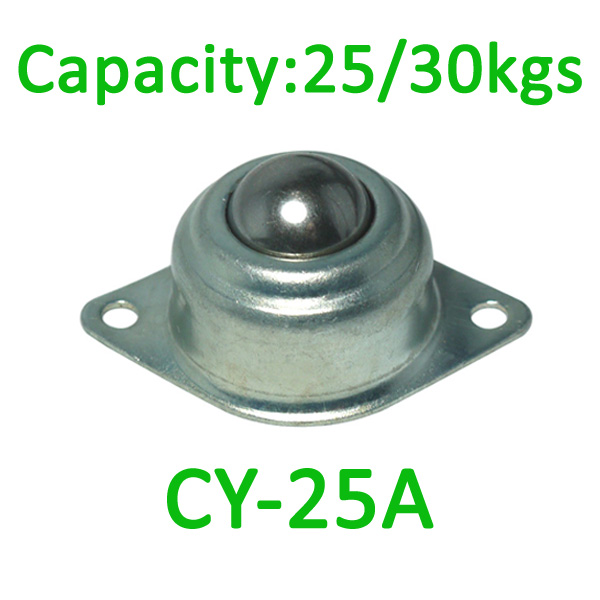
For light-load work, mounting style matters. Ahcell's CY-A flange-mount series bolts directly to table frames, with ball diameters from 15 mm to 38 mm. The CY-H base-mount series presses into recessed holes for a flush surface, and the CY-8H, at just 8 mm, suits micro-handling of small parts.
None of this requires power.
The tables are mechanical, quiet, and nearly maintenance-free. A forklift can reposition them, and operators get knee room for foot-operated tools.
For packaging lines, the choice is less about capacity than about flow. Light-load ball transfers turn a sorting table into a surface where the product moves, not the worker.
- Pre:No Information
- Next:Ball Transfers Keep Airport Baggage Moving at Junctions 2026/8/17