
Ball Transfer Unit Load Rating: How to Calculate
Engineers sizing ball transfer units for conveyor systems often rely on catalog load ratings without understanding how those numbers translate to real-world performance. The rated capacity printed on a datasheet reflects the maximum static load a single unit can support under ideal conditions — flat, rigid contact surfaces and perfectly level installation. In practice, load distribution is far from equal. Hudson Bearings, a U.S.-based manufacturer, explicitly states that equal load distribution over multiple ball transfers "is seldom, if ever achieved," because variables like surface flatness, hardness, and installation height variance all shift weight onto certain units while relieving others.
The industry-standard calculation starts with a simple formula: divide the total weight of the conveyed item by three. This safety factor of 3 is recommended by multiple manufacturers, including norelem and HPC, to account for uneven distribution. For example, if a workpiece weighs 300 kg, each ball transfer unit in the array must be rated for at least 100 kg. Norelem's mounting instructions confirm this approach, adding that the number and arrangement of units also depend on the surface properties of the goods being moved — a soft or irregular bottom surface concentrates force on fewer balls.
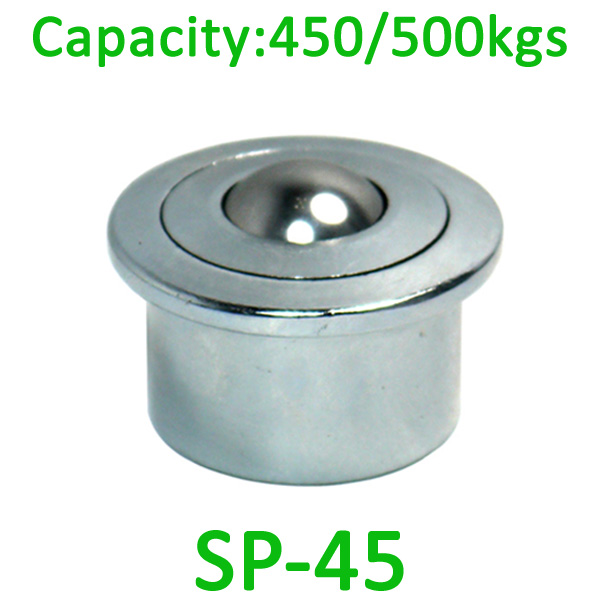
Once the per-unit load is established, engineers must determine spacing. The minimum distance between adjacent ball transfers should not exceed the shortest dimension of the load divided by 2.5, according to Hudson Bearings' technical guidance. This ensures that at least three units remain in contact with the load at all times during transport. Symmetrical arrangement is critical — placing units asymmetrically causes the load to drift or rotate unpredictably. Bosch Rexroth, which offers ball transfers ranging from size 8 to 120 mm, provides friction coefficient diagrams that help engineers predict the force required to move a given load at speeds up to 2 m/s.
Nominal life calculation follows the bearing industry standard. Effeciesse, an Italian manufacturer, publishes the formula L = (C/F)³ × 10⁶, where L is nominal life in rotations, C is the dynamic load rating, and F is the actual operating load. This cubic relationship means that even a small reduction in per-unit load dramatically extends service life. A unit operating at one-third of its rated capacity will last roughly 27 times longer than one operating at full rated load.
Omnitrack's heavy-duty series demonstrates how load ratings scale with construction. Their OTSF 4070 unit, originally designed for 2,000 kg capacity at 150 °C operating temperature, now reaches 8,000 kg per unit in the latest iteration. Rexroth's catalog lists units from 13,000 N (approximately 1,325 kg) for 60 mm balls up to 25,000 N for 90 mm configurations. These ratings assume hardened steel housings and bearing assemblies; units with corrosion-resistant steel balls carry approximately 25% less capacity due to the lower hardness of austenitic stainless steel.
Speed also degrades capacity. The recommended conveyor speed for ball transfer units is 1 m/sec according to standard installation guides. Faster speeds generate excess heat in the bearing cup, which accelerates wear — particularly for units with ball diameters between 60 mm and 90 mm. Engineers designing high-throughput systems must either select oversized units or accept reduced maintenance intervals. Spring-loaded variants, such as Omnitrack's 84 and 94 series, add compliance that absorbs shock loads but require separate dynamic load calculations since the spring preload changes the effective contact force.
The bottom surface of the conveyed item deserves as much attention as the ball transfer rating itself. OMTEC Corporation notes that soft materials will indent under point loading, causing the ball to act as a brake rather than a roller. Rough surfaces damage both the item and the transfer unit. Items with holes or voids create an even bigger problem — balls that extend into voids carry no load and may lock the item in place, especially with spring-loaded designs that rise into gaps. A proper load calculation must therefore consider not just weight and unit count but also material compatibility, surface condition, and the specific mounting configuration of each installation.
- Pre:Installing Ball Transfer Units: Bolt Pattern Guide 2026/6/1
- Next:Conveyor Transfer Point Maintenance: Reducing Spillage 2026/5/20