
Ball Transfers in Paint Booths: Part Rotation and Handling
Ball transfer units keep automotive paint and finishing lines moving in two distinct roles: they rotate parts and fixtures in front of spray guns for complete coating coverage, and they carry skids, carriers, and parts at load, unload, and transfer stations. According to Precision Conveyor Technologies, chain-on-edge conveyor systems provide precise indexing and smooth part rotation, which makes them ideal for 360° coverage in robotic spray zones.
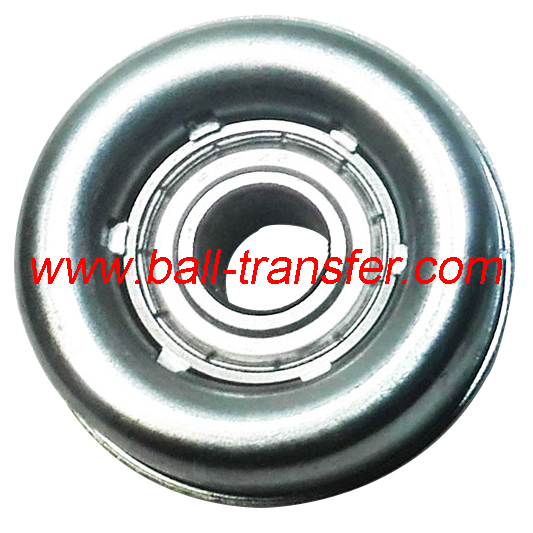
Chain-on-edge (COE) conveyors dominate high-volume finishing of rotationally symmetric parts such as wheels, rotors, fasteners, and canisters. The conveyor defines the line layout, fixture strategy, and production rate, and spindle stability is the critical factor: a wobbling spindle means missed coverage and rejected parts. Arnold Machine builds chain-on-edge lines where FANUC Paint Mate 200iA/5L robots apply primer and top coat through Krautzberger spray guns while parts rotate at least twice in front of each gun, and its pre-heat ovens run at 130 °F. Eisenmann, another major paint shop supplier, uses electrified monorail systems (EMS) for underbody coating and offers the E-Mover AGV, which carries car bodies up to 1,500 kg through skidless paint shops with LiDAR-based collision protection.
Where Ball Transfer Units Fit
Ball transfer units work at the points where parts change direction or orientation. On COE lines, ball transfers mounted in fixtures let operators spin small parts between spray passes, and at load stations they let a worker rotate a component to check coverage without lifting it. On the floor, ball transfer decks turn heavy carriers and skids between the washer, the booth, and the oven, replacing crane lifts for short moves. Heavy duty units are built for this duty: Omnitrack rates its flange-mounted range at 8,000 kg per unit with a friction ratio below 1:0.005, so a loaded skid can be rotated by hand.
Finishing lines punish bearings. Oven zones run hot, and overspray plus washdown chemicals attack unprotected steel. Bosch Rexroth specifies its ball transfer units for -30 °C to 100 °C with oil-soaked felt seals that keep out dust and emulsions. Omnitrack extends the range to -50 °C to 260 °C and fits woollen felt seals on every main ball over 12.7 mm. For paint shop floors, stainless steel housings and drain channels shed washdown water, while spring-loaded units absorb the shock when a carrier drops onto the deck.
How to Choose a Ball Transfer for a Finishing Line?
Take the heaviest part or skid that will rest on the deck, divide the weight by three, and size each unit above the result. Check temperature next: carbon steel with felt seals suits booth and load stations, stainless steel is required where washdown chemicals are used, and high-temperature variants go near ovens. Conveying speed matters too, since Bosch Rexroth rates units for operation up to 2 m/s.
- Chain-on-edge lines rotate wheels, rotors, and fasteners for full coverage (Precision Conveyor Technologies)
- Eisenmann E-Mover AGVs handle up to 1,500 kg in skidless paint shops
- Omnitrack heavy duty ball transfers: 8,000 kg per unit, friction ratio below 1:0.005
- Temperature range: -30 °C to 100 °C (Bosch Rexroth), -50 °C to 260 °C (Omnitrack)
- Felt seals and drain channels protect against overspray and washdown
Ahcell, a Chinese ball transfer manufacturer with 16 product series, builds flange-mount units such as the SP-22 (22 mm ball, carbon steel) and stainless steel versions for washdown areas, all dimensioned to ISO 15299. An integrator can drop these units into a chain-on-edge line or a floor deck and expect them to outlast the paint booth filters themselves.
- Pre:No Information
- Next:Ball Transfer Load Ratings: How to Choose the Right Unit 2026/9/14