
Stainless Steel Ball Transfers Built for Food Washdown Duty
Food and beverage plants run some of the harshest conveyor environments in industry. Production lines face high-pressure washdowns, steam, temperature swings, and aggressive cleaning chemicals, day after day. Standard carbon steel components corrode quickly under those conditions, and rust does more than weaken the hardware. Rust particles can contaminate product, and corroded surfaces harbour bacteria.
That is why stainless steel ball transfer units have become a standard specification in food processing and washdown environments. A fully stainless unit, with housing, main ball, and support balls all made of stainless steel, offers the highest level of protection and is the recommended choice for food-contact and food-adjacent applications, according to ALWAYSE, the British company that invented the ball transfer unit in 1939.
Material grade matters. Hudson Bearing, a US manufacturer, offers stainless ball transfers in 304 and 440 grades for washdown food service, dairy, pharmaceutical, and salt-air marine duty. The rule of thumb from its distributors: match the ball material to what touches it and what cleans it. European heavy-duty designs from KIPP specify stainless steel 1.4301 housings with 1.4021 ball elements, complete with dust seals and self-cleaning openings.
Sealing is the second line of defence. Good seals keep water and cleaning chemicals out of the bearing mechanism, so units survive thousands of washdown cycles without losing their smooth roll.
Cold storage and freezer operations demand more from the hardware. Stainless steel units withstand condensation and frost without corrosion, and their low-friction behaviour holds up at low temperatures. Standard lubricants may need to be replaced with low-temperature alternatives. Breweries move kegs, crates, and palletised product through washing, filling, labelling, and dispatch stages, where the wet, chemical-heavy atmosphere makes stainless construction essential.
Hygiene is about geometry as well as material. Washdown-ready conveyor designs favour smooth surfaces with no hidden crevices where residue can collect. Stainless ball transfer units support this directly, because they are easy to clean and their simple construction removes the bacterial harbourage points that can halt a production line.
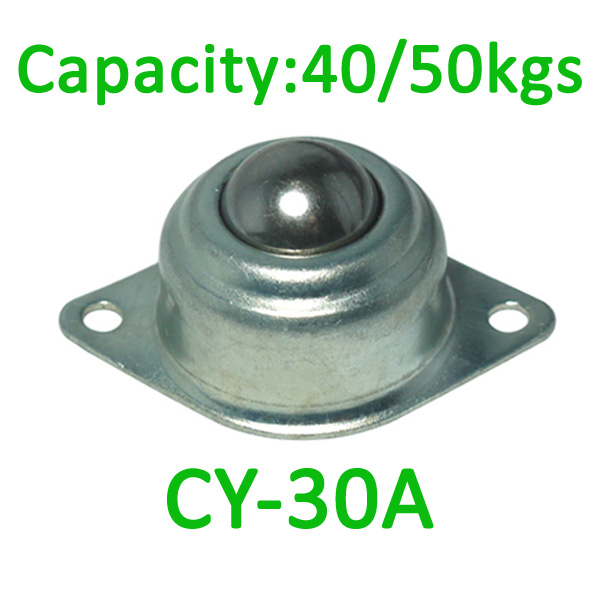
Manufacturers such as Ahcell offer flange-mount stainless ball transfer units in the CY-A series, with ball diameters from 15 mm to 38 mm. Models like the CY-15A and CY-30A bolt directly onto conveyor beds and work tables, and the stainless variant suits humid, washdown, and clean-room applications.
For plant engineers, the calculation is straightforward. Corroded components mean downtime, contamination risk, and replacement cost. Stainless steel units cost more up front, yet they keep rolling through years of caustic washdowns, a trade most food processors accept without hesitation.
- Pre:Ball Transfers Keep Airport Baggage Moving at Junctions 2026/8/17
- Next:Ball Transfer Installation and Maintenance Guide 2026/8/3