
Ball Transfer Units in Packaging and Parcel Sortation System
Why Packaging and Parcel Sortation Needs 360-Degree Movement
Packaging lines and parcel sortation hubs operate under relentless pressure. E-commerce volumes keep climbing, and facilities must process thousands of packages per hour with near-perfect accuracy. Traditional roller conveyors move loads in a straight line well enough, but the moment a package needs to change direction, rotate, or merge onto another line, the system hits a bottleneck.
Ball transfer units solve this by enabling omnidirectional movement on a single surface. A package sitting on an array of ball transfers can be pushed forward, sideways, diagonally, or rotated in place without any mechanical lift or redirection mechanism. This capability is changing how modern sortation systems are designed.
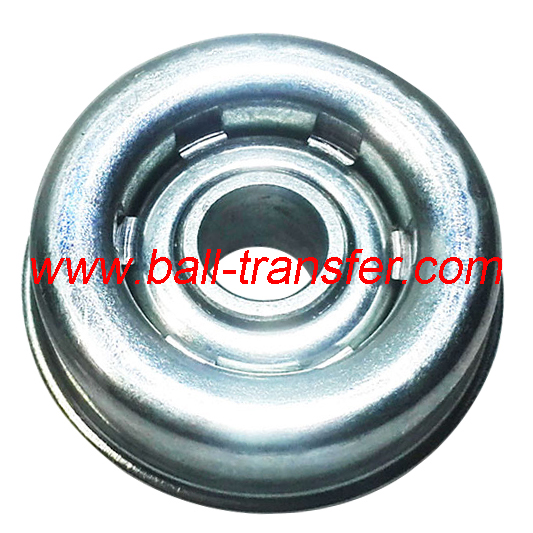
Omnidirectional Advantage vs. Roller Conveyors
Roller conveyors are excellent at transporting flat-bottomed loads along fixed paths. They are simple, durable, and well understood. But their limitation is directional. A package on rollers can only go one way unless it hits a diverter, a pop-up wheel, or a mechanical gate. Each of these adds complexity, cost, and a potential jamming point.
Ball transfer units remove that constraint. A single ball transfer table or a section of ball transfer inserts at a conveyor junction lets operators redirect packages by hand or via automated pushers with no change in conveyor direction. Studies from logistics automation projects show that replacing even short roller sections with ball transfer arrays reduces manual handling time by up to 45 percent in sorting applications.
There are trade-offs. Ball transfers require flat-bottomed loads. They cannot handle cylindrical items or bags without fixturing. And per-unit load capacity is generally lower than equivalent-size roller sections. For mixed parcel hubs handling mostly cartons, totes, and polybags though, the omnidirectional benefit far outweighs these constraints.
2026 Trends in Logistics Automation
The global ball transfer unit market reached an estimated USD 1.8 billion in 2025 and is projected to grow to USD 3.1 billion by 2034 at a CAGR of 6.2 percent. Packaging and sortation applications account for a large share of this growth. Several specific trends are accelerating adoption.
Automated sortation systems increasingly use ball transfer zones at merge points where multiple conveyor lines feed into a single high-speed sorter. Instead of complex gating mechanisms, a ball transfer array allows packages to slide naturally into the merge lane with minimal impact force. This reduces jams and extends sorter life.
Space-constrained facilities benefit from ball transfer turntables and rotary stations that let a single operator redirect packages to multiple outbound lanes without walking. In newer hub designs, ball transfer cells are embedded directly into workstation benches so packers can rotate and position boxes for labeling or taping without lifting.
Sustainability requirements also push adoption. Stainless steel ball transfer units are now standard in food-grade packaging lines where washdown is required. Nylon ball options provide non-marking surfaces for delicate retail packaging. Both materials eliminate the need for lubricants in sensitive environments.
Real-World Performance Data
Logistics facilities that installed ball transfer sections at sortation induction points report measurable improvements. One e-commerce hub in Southeast Asia deployed 280 meters of light-duty ball transfer conveyor for parcel sorting. Sorting efficiency rose 42 percent, and the error rate dropped from 1.2 percent to 0.15 percent. The investment paid back in under eight months.
In electronics packaging lines, ball transfer tables at assembly workstations reduced product damage by eliminating the need to slide or drag components across fixed surfaces. Workers can rotate partially assembled products freely, improving ergonomics and reducing fatigue-related errors.
Integration with Existing Systems
Retrofitting ball transfer sections into existing roller conveyor lines is straightforward. Drop-in insert plates let maintenance teams remove a section of rollers and bolt in a pre-assembled ball transfer panel. Stud-mount and flange-mount units can be added to existing tables or frames without custom fabrication. This modularity means facilities can start with a single ball transfer zone and expand as needed.
The key design consideration is ball spacing. For stable package support, planners typically space ball transfer units so that any load contacts at least three balls at all times. Larger or heavier packages require tighter spacing or heavier-rated units. Most manufacturers provide load distribution calculators to simplify this step.
Bottom Line for 2026
Ball transfer units are not a replacement for roller conveyors across the board. But for packaging lines and parcel sortation hubs that need multidirectional flexibility, they deliver a measurable operational advantage. The 2026 trend toward higher throughput, tighter floor space, and lower manual handling makes omnidirectional ball transfer zones an increasingly standard feature in modern facility design.