
Heavy-Duty Ball Transfers for Steel Mill Cut-to-Length Lines
The Challenge of Moving Heavy Steel in Processing Lines
Steel mill cut-to-length lines handle some of the heaviest loads in industrial material handling. Coils weighing 20 to 40 tons are unrolled, leveled, and cut into sheets that then need to be stacked, transferred, or routed to further processing. Moving these sheets — often at high temperature with sharp edges and demanding surface quality requirements — places extreme stress on any conveying component.
Traditional methods rely on roller conveyors, drag chains, or custom wheeled carts. Each has drawbacks. Rollers leave contact marks on polished surfaces. Chains wear quickly under heavy cyclic loads. Wheeled carts require expensive track systems and limit directional flexibility. Heavy-duty ball transfer units offer a different approach that addresses these problems directly.
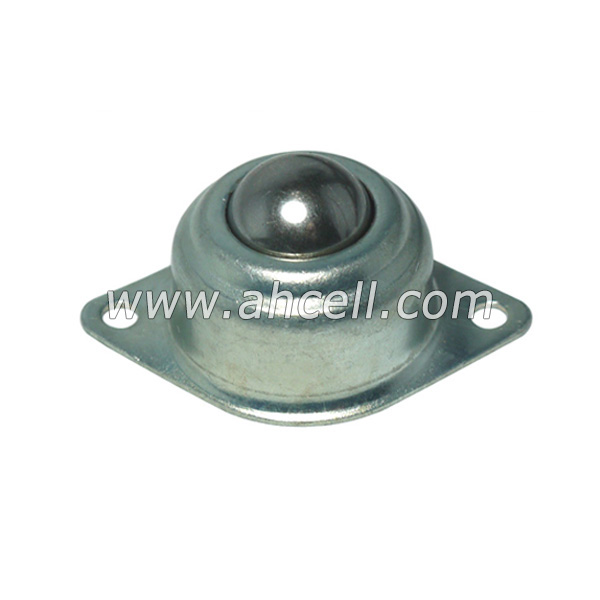
The BTFM Series: Built for 8,000 kg Per Unit
The BTFM series of flange-mount heavy-duty ball transfer units represents the upper end of load capacity in the ball transfer product spectrum. Each unit is rated to support up to 8,000 kilograms — that is eight metric tons per individual ball unit. Used in arrays, these units distribute the weight of steel sheets across multiple contact points while allowing full 360-degree movement.
The design is simple but robust. A large main ball, typically 76 to 254 mm in diameter, rests on a bed of hardened support balls inside a steel housing. The main ball is the only component that contacts the load. Because it rotates freely in any direction on the support bearing array, a steel sheet resting on a grid of BTFM units can be pushed sideways, rotated, or moved diagonally with surprisingly low effort.
Construction is all-steel. Housing, mounting flange, and main ball are made from hardened carbon steel or stainless steel depending on the operating environment. Zinc-plated and galvanized options provide corrosion resistance for high-humidity mill conditions. The flange mount design allows bolting directly into structural steel frames without special adapters.
Why Steel Mills Are Switching from Rollers and Wheels
Cut-to-length lines process sheet widths from 48 inches to over 96 inches, handling thicknesses from thin gauge up to one inch or more. The sheets exiting the shear or leveler need to move to stacking stations or downstream processes. Roller conveyors work, but they constrain movement to a single axis. If a sheet needs to be rotated for stacking or diverted to a different line, additional equipment is required.
Ball transfer arrays eliminate this constraint. A single ball transfer table installed at the exit of a cut-to-length shear lets the operator or an automated pusher redirect sheets in any direction. Sheets can be rotated 90 degrees for cross-stacking without lifting. They can be moved sideways into inspection stations. They can be diverted left or right into multiple stacking lanes using the same surface.
High-temperature operation is another factor. Steel sheets exiting a temper mill or a hot-rolled cut-to-length line can exceed 120 degrees Celsius. Standard roller bearings and seals degrade quickly at these temperatures. Heavy-duty ball transfer units, particularly the BTFM series with exposed steel ball construction and no elastomeric seals to fail, tolerate sustained heat better. The all-metal construction eliminates seal embrittlement and lubricant breakdown that plague traditional roller bearings in hot environments.
Surface quality also drives the switch. Roller conveyors have a small contact area per roller, which concentrates pressure and can imprint roller patterns onto soft or polished sheets. Ball transfer units distribute the load over a larger ball surface area. The rolling contact is gentler, and the smooth spherical surface reduces marking risk. For stainless steel and prepainted sheet processing, this is a significant advantage.
Historical Roots in British Steel
The concept of heavy-duty ball transfer units for steel mill applications dates back to 1954. The original design was commissioned by British Steel to handle drums of molten steel. Workers had been using inverted castors as a stopgap, but the heat and load destroyed them quickly. Purpose-built ball transfer units with all-steel construction and 100 percent pre-assembly testing solved the problem. That same manufacturing philosophy — every unit tested before it leaves the factory — continues today for BTFM and similar heavy-duty lines.
Modern steel mills in North America, Europe, and Asia now use track-mounted ball transfer systems for coil handling and sheet transfer. The SW and SWG series, designed for track mounting, allow heavy loads to travel along defined paths while maintaining omnidirectional capability at stops and transfer points.
Installation Considerations for CTL Lines
Integrating ball transfer sections into a cut-to-length line requires attention to several factors. The ball array must be dense enough that every sheet contacts multiple units at all times. For standard sheet widths from 48 to 96 inches, manufacturers recommend a grid spacing of no more than 12 inches between ball centers in both directions. Heavy-gauge sheets may require tighter spacing or individual units with higher load ratings.
Mounting surface flatness is critical. Even small deviations cause load concentration on fewer balls, reducing effective capacity and accelerating wear. Steel mill installations typically use reinforced structural steel frames with machined mounting plates to ensure level alignment. Flange-mount units secured with Grade 8 bolts provide reliable attachment under vibration and thermal expansion cycles.
Sealing in mill environments requires attention. While the BTFM series uses all-metal construction, the gap between the main ball and the housing can admit mill scale, metal dust, and coolant. Periodic cleaning with compressed air and a light oil application on the support bearings maintains smooth rotation. Some installations use compressed air purge fittings to keep debris out of the housing cavity.
Economic Justification
The upfront cost of heavy-duty ball transfer arrays is higher than standard roller conveyor sections. However, steel mill operators report that the elimination of directional change equipment, reduced surface marking, and lower maintenance frequency on ball transfers versus roller bearings offsets the initial investment within 12 to 18 months. The ability to reconfigure a ball transfer table for different product flows by simply adjusting pusher locations adds long-term flexibility that roller systems cannot match.
For steel mills processing 50,000 to 200,000 tons per year through a single cut-to-length line, the reliability of heavy-duty ball transfer units directly translates to uptime. A jammed roller section can stop an entire line for hours. A stuck ball transfer unit, by contrast, can be individually replaced in under 10 minutes without removing adjacent units.
Looking Ahead
As steel service centers demand more flexibility from their cut-to-length lines, heavy-duty ball transfer systems are becoming a standard specification rather than a specialty option. The combination of 8,000 kg per-unit capacity, high-temperature tolerance, and omnidirectional movement makes the BTFM series a practical choice for mills that need to move heavy sheets without directional constraints.
- Pre:Ball Transfer Installation and Maintenance Guide 2026/8/3
- Next:Ball Transfer Units in Packaging and Parcel Sortation System 2026/7/20